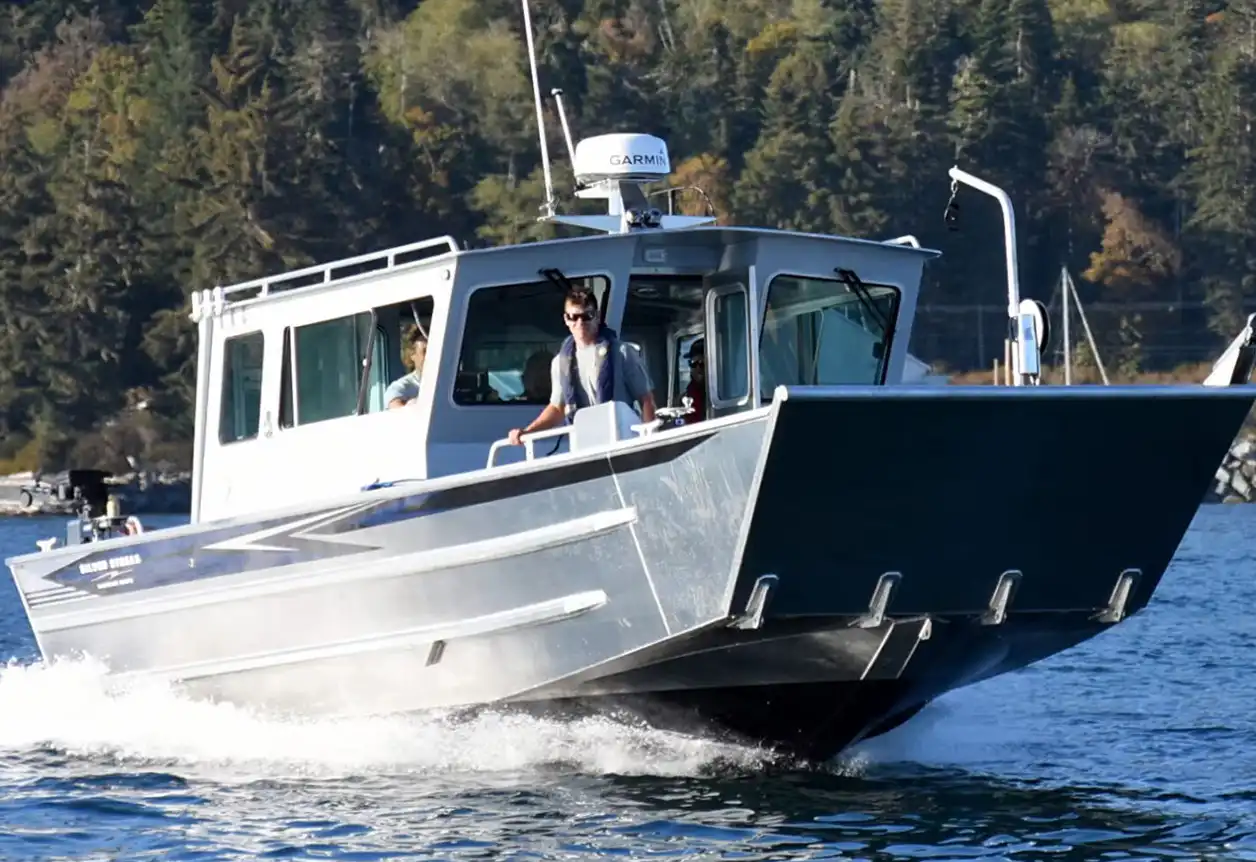
1. The Numbers: Payload at the Same Length
At 10 meters, a standard flat-bottomed cargo boat can carry 8 to 10 tons, while a well-built 10-meter aluminum landing craft typically carries around 4 tons, less than half as much. This is not about build quality: the two boats are designed for different jobs. A cargo boat is built to carry as much as possible between docks, while a landing craft is built to deliver cargo where there are no docks. Once you see that, it becomes clear why carrying less can be the smarter business choice.
2. Shallow Draft and Flat Bottom: Trading Displacement for Beach Access
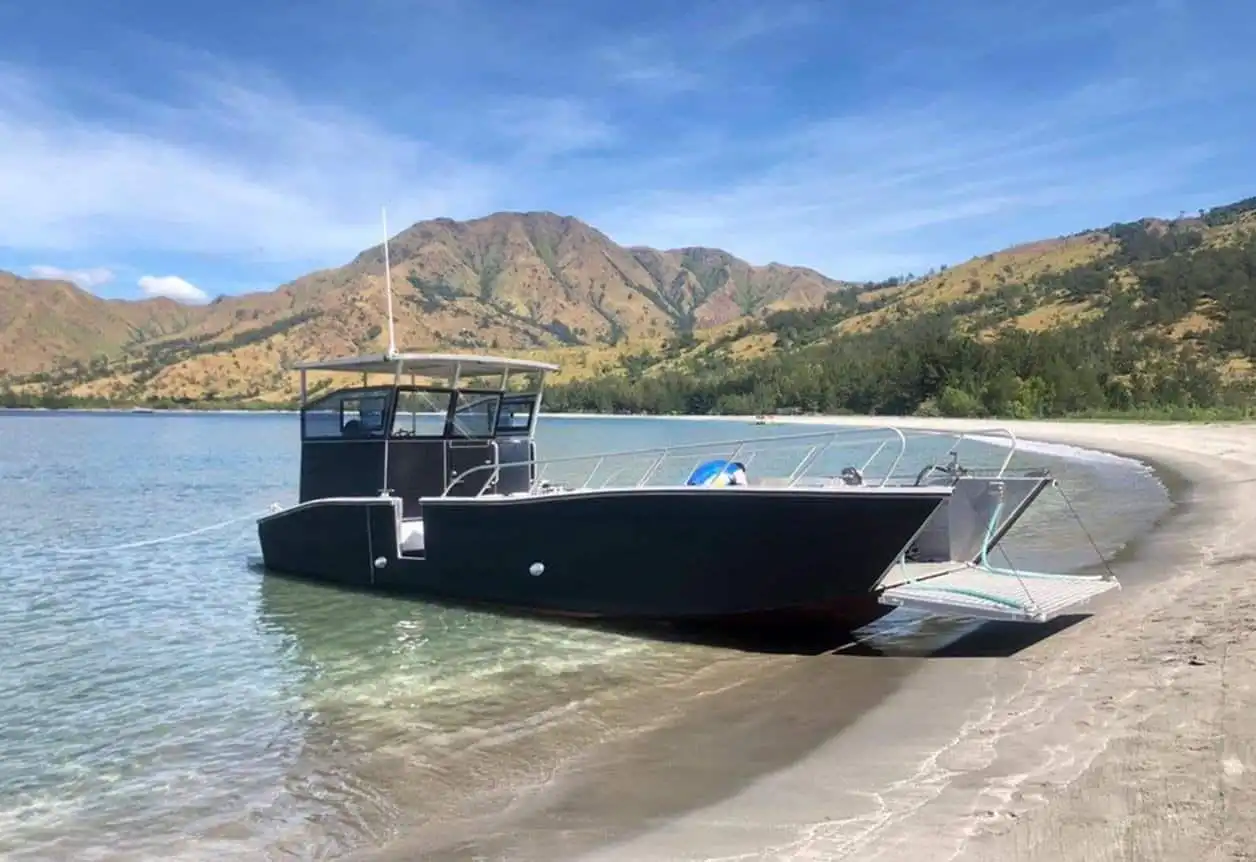
A landing craft can run onto a beach because of its very shallow draft and flat-bottomed hull. Our 9-meter aluminum landing craft, for example, draws only 0.31 meters at full load, so most of the hull sits above the waterline and there is little volume below it. By Archimedes’ principle, carrying capacity depends on the weight of water displaced, so a shallower draft means less underwater volume and a lower payload. Cargo boats, built for maximum load, use deep-V or round-bilge hulls that often draw more than 1.5 meters, and their larger underwater volume gives them more capacity. Think of an off-road vehicle and a flatbed truck: the off-road vehicle goes almost anywhere but carries less, while the truck hauls heavy loads but needs a good road. A landing craft is the off-road vehicle of the sea.
3. Structural Reinforcement: Strength for Repeated Beaching
A landing craft’s hull must handle two loads that ordinary cargo boats never see: the impact of the bottom hitting the beach, and the bending stress when part of the hull is unsupported while aground. That is why aluminum landing craft usually have 6 to 7 mm bottom plating and extra reinforcement in critical areas. The added structure weighs more and reduces payload, but it keeps the landing craft safe where there are no docks. For work on remote islands, this strength is not optional: the hull has to stay true after hundreds of beach landings.
4. Bow Ramp and Bow Door: Space Well Spent
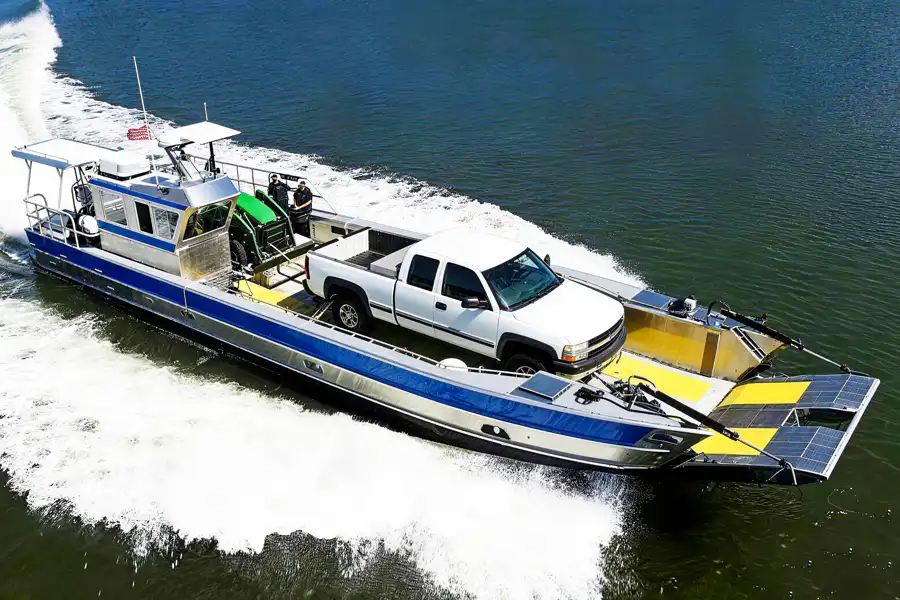
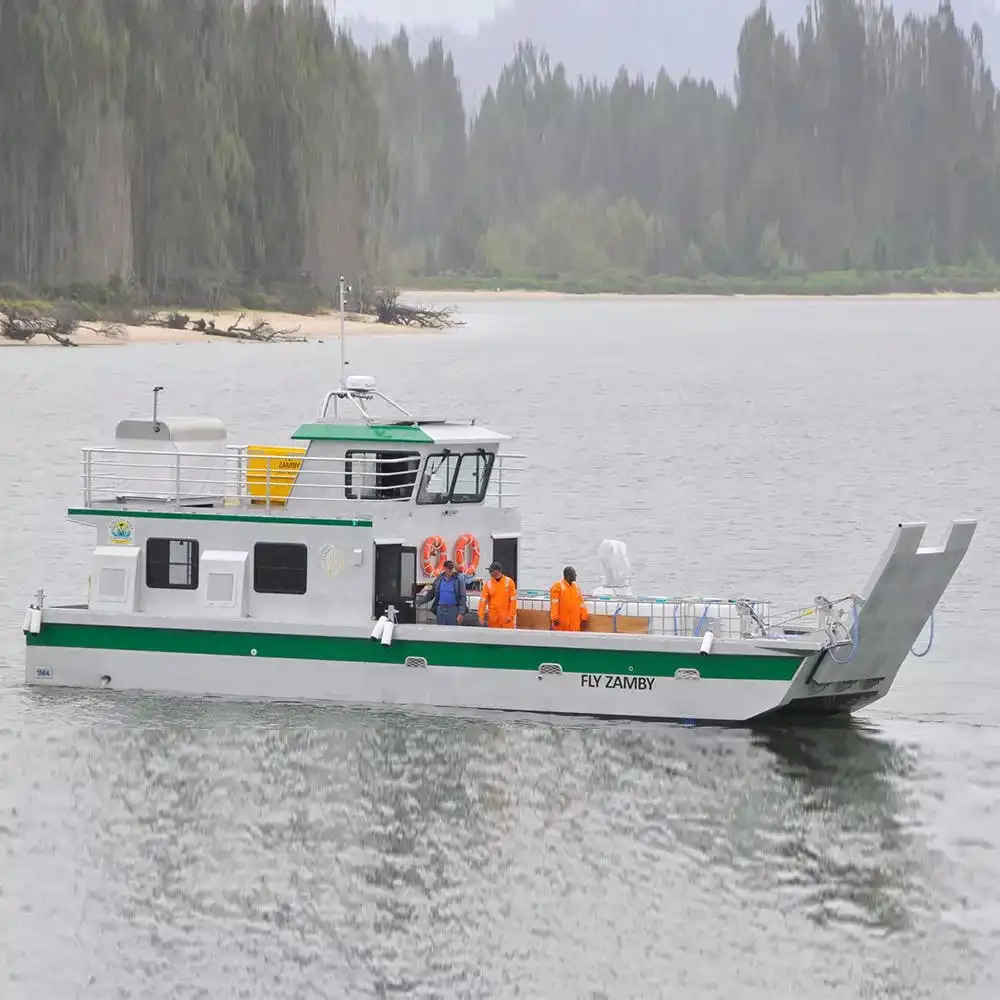
The bow ramp and bow door are another reason landing craft carry less. The full-width ramp system (manual winch or hydraulic, depending on the model) and its supporting structure take up part of the hull’s forward length and weight. On a 12-meter aluminum landing craft, for example, the bow door mechanism is about 1.5 meters long, and that space cannot be used for cargo. Cargo boats have no such structure and can use their full length. Yet it is exactly this ramp that turns the landing craft into a bridge after beaching, so vehicles and cargo can drive straight ashore. Where there are no docks, the trade-off is well worth it. As an island resort operator told us: “Without that ramp, I’d have to hire a small boat to shuttle cargo back and forth every time I unload. The extra cost over the course of a year would be enough to buy half a ship.”
5. The Real Value: No Infrastructure Costs
Now back to the business decision: do you need a boat that carries more, or one that can go ashore? If every destination has a deep-water dock, a standard cargo boat is the more economical choice. In reality, many islands, coastal construction sites, aquaculture zones and tourist beaches have no docking facilities, and building a dock can easily cost hundreds of thousands or even millions of dollars and take years of approvals and construction. With an aluminum landing craft, you avoid that investment at the cost of carrying a few tons less, and deliveries no longer have to wait for a dock. For small and medium-sized businesses, that is often the smarter financial decision.
6. How to Choose the Right Boat Type for Your Business
If you mainly carry dense bulk cargo such as sand, gravel or grain and have a fixed dock, a standard cargo boat is the better choice. If you need to move vehicles, construction machinery, containers or perishables to places without docks, a landing craft is the right tool. Our range runs from 7.9 to 21 meters, with payloads from 1 to 30 tons: the 7.9-meter model suits small supply runs, the 9- to 10-meter models carry pickup trucks or 3 to 4 tons of cargo, and the 12- to 14-meter models take two trucks or 6 to 10 tons of building materials. Our engineers will help you find the right balance between payload and access based on your route’s water depth, cargo and landing conditions. The best boat for your business is not the one that carries the most, but the one that earns you the most.
For a step-by-step way to match payload, draft and budget to your business, see our landing craft buyer’s guide.
7. Frequently Asked Questions
Can the load capacity of a landing craft be increased by widening the hull?
Yes. Our 11-meter wide-body aluminum landing craft (4-meter beam) carries nearly twice as much as the 9-meter narrow-body version (2.45-meter beam). A wider beam does affect shallow-water handling (draft increases slightly) and road transport (oversize loads), so we recommend the best length-to-beam ratio for your needs rather than simply chasing maximum payload.
Do the load capacity specifications for aluminum landing craft refer to “safe load” or “maximum load”?
We specify safe load, which is the weight the hull can stably carry over the long term under normal navigation and beaching conditions, with sufficient safety margins built in. We do not recommend overloading, as this increases the risk of grounding, accelerates structural fatigue, and reduces stability in rough sea conditions. If you have occasional heavy-load transport needs, please discuss reinforced design options with us.
Is there a way to increase load capacity without increasing the draft?
Only within limits. Widening the beam or reducing structural weight can add payload without a deeper draft, but both involve trade-offs. Some clients instead plan loads by route, carrying less in very shallow areas and more where the water is deeper. We recommend first establishing your typical operating depth and then choosing a matching boat type, rather than looking for a one-size-fits-all design. Specialized tools are often more reliable and economical than general-purpose ones.