1. Operating Costs: Better Fuel and Payload Efficiency
Fuel is one of the biggest long-term costs of any commercial operation. Thanks to marine-grade aluminum’s high strength-to-weight ratio, an aluminum landing craft can weigh 30% to 50% less than a steel boat of the same size without losing structural strength. Our 10-meter aluminum landing craft, for example, combines a 4-ton payload with a light hull and uses about 25% less fuel than a steel boat at the same speed. On daily round trips the savings add up: over 200 voyages a year, fuel costs alone can fall by thousands of dollars. The lighter hull also leaves more capacity for payload, so every liter of fuel moves more cargo.
2. Maintenance Costs: Long-Term Savings from Corrosion Resistance
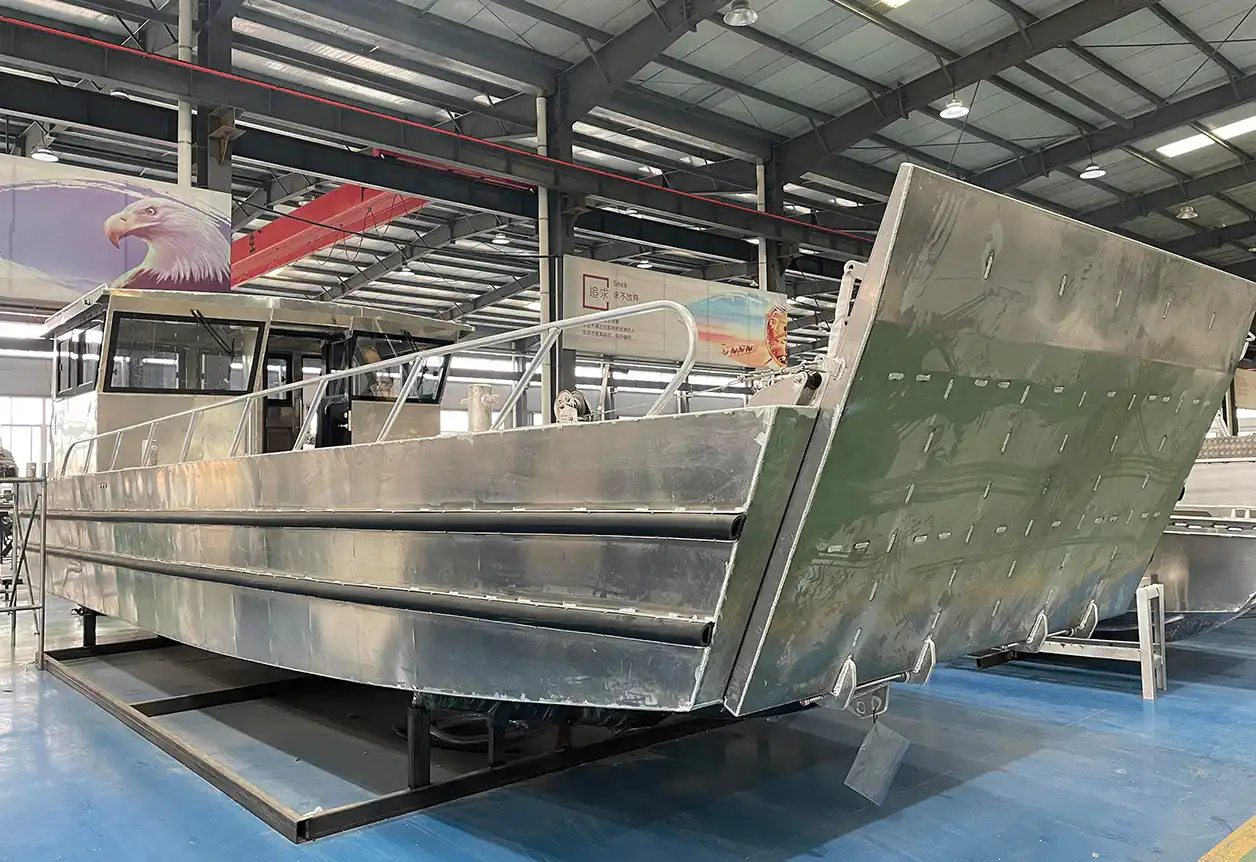
Corrosion at sea is constant and easy to overlook. Steel boats need dry-docking for rust removal and repainting every one to two years, at a cost of tens of thousands of dollars each time, and the downtime interrupts business. Marine-grade aluminum such as 5083 alloy forms a dense protective oxide layer that resists seawater corrosion naturally, so aluminum landing craft need no regular anti-corrosion treatment, and routine maintenance is mostly cleaning and inspection. Over a ten-year operating cycle, maintenance costs for an aluminum landing craft are only about 40% of those for a steel boat, roughly 60% lower. For a small business running several landing craft, those savings can help fund expansion.
3. Customization Capabilities: The Flexibility of Aluminum Fabrication
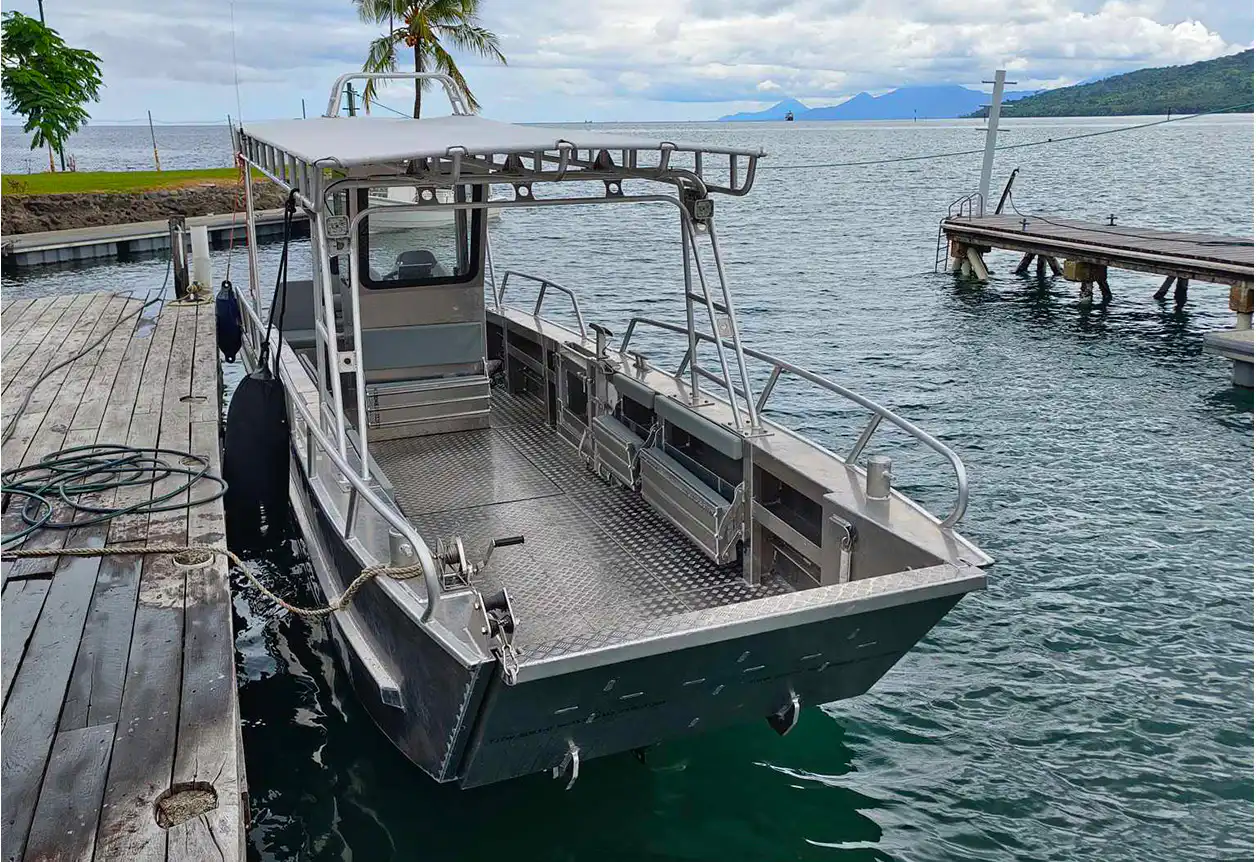
Commercial requirements are rarely standard. One client needs a deck crane, another wants different passenger seating, and a third needs a wider gangway to suit a particular beach slope. Aluminum landing craft are easy to adapt: marine-grade aluminum welds and machines well, so our factory can cut, weld and modify each craft to customer requirements without compromising hull strength. An island resort operator once asked us to add a side door to a 9-meter aluminum landing craft so divers could enter the water from the side, and the work was finished in two weeks. Steel boats are costly and slow to modify, and fiberglass hulls are very hard to alter structurally, so aluminum is the easiest way to get a landing craft built around your needs.
4. Resale Value: Backed by the Material Itself
Commercial buyers should think about resale value as well as purchase price. Aluminum landing craft have a natural advantage here. Aluminum has high scrap value: even after ten years of use, the hull can be recycled, with a residual value of 40% to 50% of the original material cost. A fleet operator in Southeast Asia told us that when he renewed his fleet, an aluminum landing craft with eight years of service still sold for about 60% of the price of a new one. Steel boats lose much more value because of corrosion, and fiberglass boats have almost no recycling value and can even cost money to dispose of. Over its whole life, an aluminum landing craft holds its value far better.
5. Market Proof: The Choice of Commercial Fleets Worldwide
Aluminum is now the dominant material for new commercial landing craft worldwide. From resort logistics fleets in the Maldives to salmon farm support craft in Norway’s fjords and passenger-cargo shuttles between Southeast Asian islands, aluminum landing craft work all over the world. Their owners have proven the durability, cost-effectiveness and reliability of marine-grade aluminum over years of operation, and many of our clients have switched their whole fleet to aluminum after their first aluminum landing craft. As one Australian client put it: “Once you’ve used an aluminum boat, you’ll never want to touch a steel one again.”
For a step-by-step guide to choosing an aluminum model, see our landing craft buyer’s guide.
6. Frequently Asked Questions
How much more expensive are aluminum landing craft compared to steel boats? Is this investment worth it?
The purchase price is typically 15% to 25% higher than for a steel boat. Over a landing craft’s service life, however, fuel savings, lower maintenance costs and higher resale value usually recover the difference within 3 to 5 years, and with daily transport work the total cost of ownership over ten years is much lower than for steel. We recommend deciding on total cost of ownership rather than purchase price.
Is marine-grade aluminum truly corrosion-resistant?
Any metal can corrode in extreme conditions, but marine-grade aluminum, especially 5083 alloy, corrodes very slowly in seawater. In practice, as long as direct contact with dissimilar metals is avoided (for example with insulating gaskets) and salt is rinsed off regularly with fresh water, the hull can last more than 20 years. Many of our clients’ landing craft are still structurally sound after more than a decade and look almost new after a simple clean.
Is the strength of aluminum landing craft sufficient? Can they withstand the impact of beaching?
Marine-grade aluminum is stronger than ordinary steel for its weight. Our landing craft have 6 to 7 mm bottom plating, with extra reinforcement in critical load-bearing areas to absorb the impact of beaching, and aluminum’s toughness means it does not crack in a brittle way on impact. All models are CE certified, and their structural strength meets international standards.