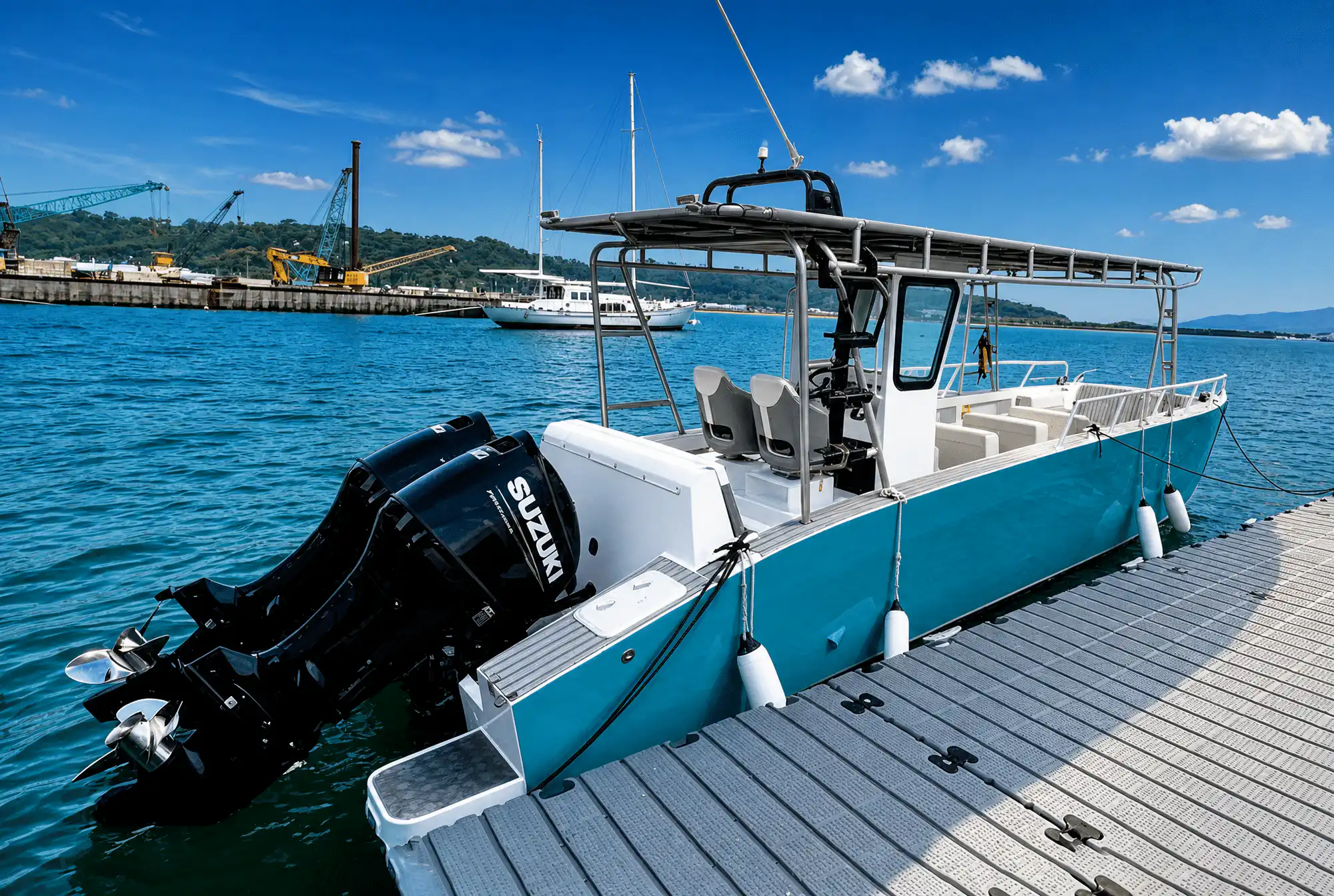
1. The Basics: What “Inboard” and “Outboard” Mean
Before comparing propulsion options, it helps to be clear on the terms. An outboard engine combines the engine, gearbox and propeller in a single unit mounted on the outside of the transom, where it can be tilted up or removed completely. An inboard engine sits inside the hull in an engine room and drives a propeller outside the hull through a shaft that passes through the bottom. The two differ fundamentally in where they are installed and how they are built, and this directly affects the landing craft’s performance, maintenance and service life. Put simply, an outboard is a complete power package hung on the transom, while an inboard is an engine housed inside the hull and connected to an external propeller. Understanding this difference is the first step toward the right choice.
2. Outboard Advantages: Flexible, Lightweight and Easy to Maintain
Outboards are the most common propulsion choice for small and medium aluminum landing craft. Their biggest advantage is integration: the whole unit is mounted outside the transom, takes up no space inside the hull and leaves the maximum deck area for cargo. Maintenance is also easy; most routine jobs, such as changing engine oil, spark plugs and gear oil, can be done without hauling out at a yard. If an engine needs a major overhaul or replacement, the whole outboard can be removed and swapped for a spare, often getting the landing craft back to work within a day. A 9-meter aluminum landing craft, for example, runs well on 300–500 hp of outboard power for daily work. For smaller operators with limited budgets who want to start working quickly, outboards are the easiest way in.
3. Inboard Advantages: More Power, Less Noise and Better Fuel Economy
Inboard engines are more common on large aluminum landing craft. The engine sits in its own compartment inside the hull and drives the propeller through a shaft. This brings two clear advantages. First, power is transmitted more efficiently, giving more thrust for the same power, which suits heavy loads and long-range work. Second, because the engine is enclosed by the hull, noise and vibration in the wheelhouse and passenger cabin are much lower than with outboards, making for a more comfortable ride. For long trips or passenger work, that comfort is a real competitive advantage. Inboards also typically use about 10% to 15% less fuel than outboards of the same power; for commercial landing craft running more than 500 hours a year, that adds up to substantial fuel savings. A client who runs island tours made this comparison: on a 12-meter landing craft, the annual fuel savings from inboard engines were enough to cover a full year of crew wages.
4. Space vs Ease of Maintenance: What the Engine Room Means for You
An inboard engine needs a dedicated engine room, so part of the hull’s internal volume goes to the engines and related equipment. On small and medium landing craft, this space may come out of the cargo or passenger area, so the trade-off needs careful thought. Routine inboard maintenance, such as checking the cooling system or changing oil filters, is done inside the engine room, and the size of the access space directly affects how easy that is. For breakdowns and unplanned repairs, inboards are considerably harder to fix and take more labor hours than outboards: mechanics have to work inside the engine room, and removing some large components may even mean dismantling surrounding structure. When choosing propulsion, balance day-to-day comfort against how hard repairs will be when something goes wrong. Experienced owners who choose inboards look closely at whether the engine room leaves enough working space, because a cramped engine room makes every service a struggle.
5. Where to Draw the Line: When to Choose Outboards and When to Choose Inboards
The dividing line usually falls at around 11 to 12 meters. On small aluminum landing craft up to about 10 meters, outboards are by far the most common choice, with clear advantages where space is limited, budgets are tight and maintenance needs to be simple. On landing craft over 11 meters, twin or triple outboards remain a reliable choice for cargo work on short routes, but if the craft will mainly carry passengers or make long continuous runs, the comfort and fuel economy of inboards deserve serious consideration. If your waters have a lot of floating debris or shallows, remember that outboards can be tilted up to clear obstacles, while an inboard’s propeller and shaft are fixed in place and more exposed to damage. As one experienced owner summed it up: outboards for short trips, cargo and shallow water; inboards for long trips, passengers and deeper water. This rule of thumb simplifies things, but it is a good starting point for first-time buyers.
6. Purchase Price vs Long-Term Running Costs: Look at the Total Cost
For the same power, outboards usually cost less up front than inboards. But total cost of ownership is more than the purchase price; it also includes fuel, maintenance and resale value. Inboards cost more to buy but generally do better on fuel efficiency, durability and demand on the second-hand market. For commercial landing craft running more than 500 hours a year, the extra cost of an inboard is often recovered within 3 to 5 years through fuel savings and longer service intervals. When setting a budget, compare the options over a five-year period, listing the purchase price, average annual fuel and maintenance costs and the estimated resale value after five years. The result is often different from what intuition suggests. One owner ran the numbers when replacing his landing craft: the inboard version cost $20,000 more, but over five years he saved $15,000 on fuel and $8,000 on maintenance and sold it for $5,000 more, so it came out ahead overall. Tell us the size of landing craft you need, your route and annual operating hours, and we will recommend the propulsion setup that fits your operation.
For how power fits with size, payload and range when you choose a model, see our landing craft buyer’s guide.