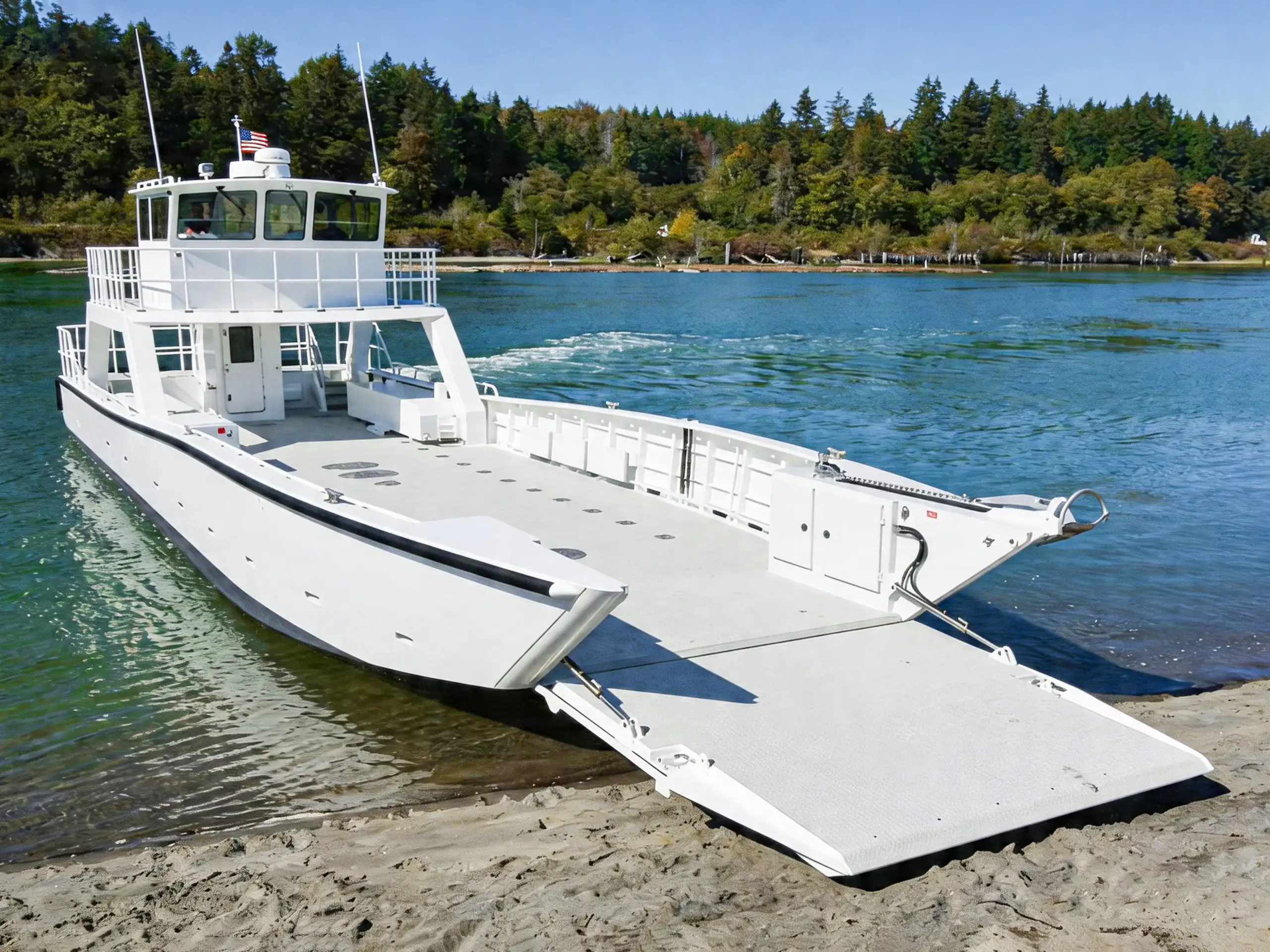
Buying a landing craft is a working decision. The right one carries your typical load, reaches your shallowest landing point and keeps working day after day at a running cost that makes sense. A model that is too small limits what you can carry; one that is too large costs more than it needs to and may not reach the beaches you serve.
This guide walks through the decisions in the order we work through them with buyers: the job, size and payload, water depth, layout, power, hull build, options, rules, budget and delivery. Each step links to a more detailed article if you want to go deeper. The figures come from our own range of 7.9–21 m aluminum landing craft; other builders’ designs will differ, but the questions to ask are the same.
1. Start With the Job You Need It to Do
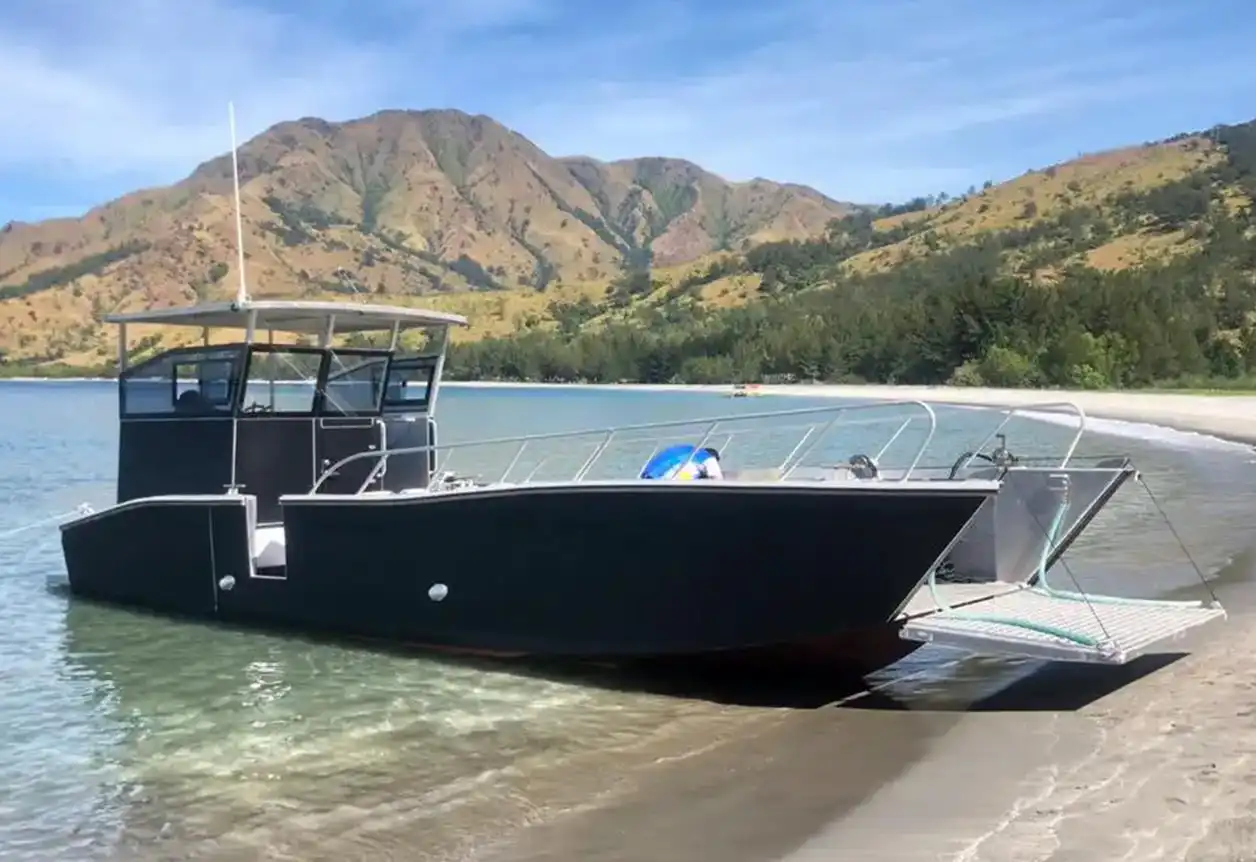
A landing craft is the right tool when you need to deliver cargo, vehicles or people to places without a proper dock: beaches, riverbanks, island shorelines, construction sites and farm sites. Its flat or shallow-V hull and bow ramp let it run onto the shore and unload directly. If every stop on your route has a deep-water wharf, a conventional cargo boat may carry more for the money. Our articles on why landing craft carry less than cargo ships and how landing craft differ from other workboats explain the trade-off.
Most buyers use their landing craft for one or more of these jobs:
- Cargo and supply runs to islands, resorts and remote communities: see cargo and supply transport landing craft.
- Vehicles and machinery, from ATVs and pickup trucks to excavators: see landing craft for vehicle transport and construction and work support landing craft.
- Passenger and crew transfers to beaches, islands and offshore work sites: see passenger and crew transfer landing craft.
- Aquaculture and fisheries, carrying feed, fry and equipment to farm sites: see fisheries and aquaculture landing craft.
- Emergency response, including flood relief and search and rescue: see emergency response and rescue landing craft.
- Several of these in one hull, switching roles by season or project: see multi-purpose landing craft.
Before you compare models, write down three numbers: the weight of your heaviest single item, a typical load per trip, and the depth at the shallowest point where you must land. Almost every later decision follows from them.
2. Choose the Size: Length, Beam and Payload
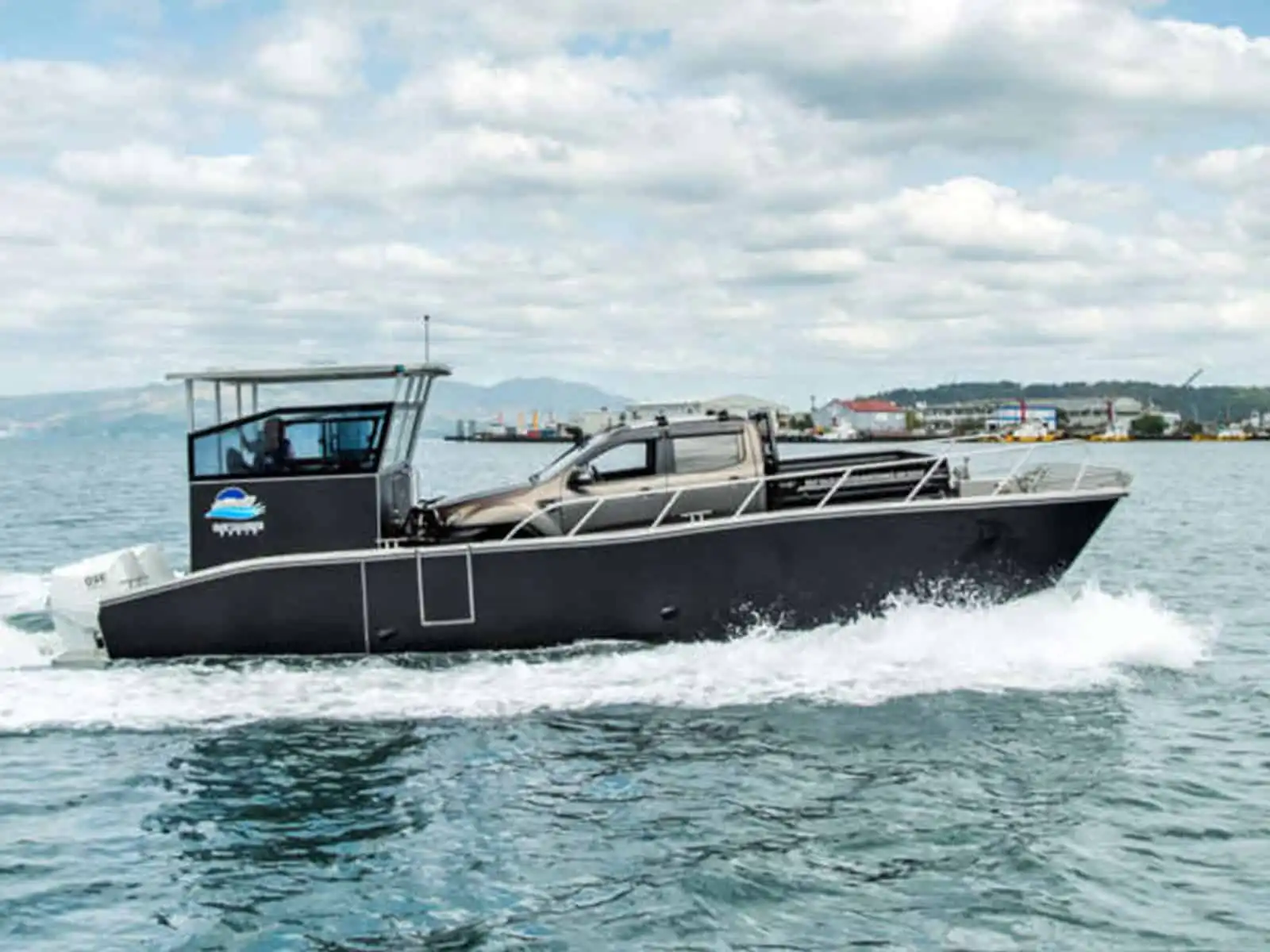
Payload grows with length and beam. A longer hull adds deck length; a wider beam adds deck area and stability, which matters when you carry vehicles or tall loads. Part of the forward length always goes to the bow ramp and its structure, so the usable deck is shorter than the overall length. Our article on how length affects payload explains the relationship in detail.
The table below summarizes our standard models. Payload is the maximum load; final figures depend on the specification you choose.
| Model | Length | Beam | Payload | Layout | Best for |
|---|---|---|---|---|---|
| 7.9m Landing Craft | 7.9 m (26 ft) | 2.45 m | 1 ton | Steering wheelhouse | Light supply runs, aquaculture support, short coastal transfers |
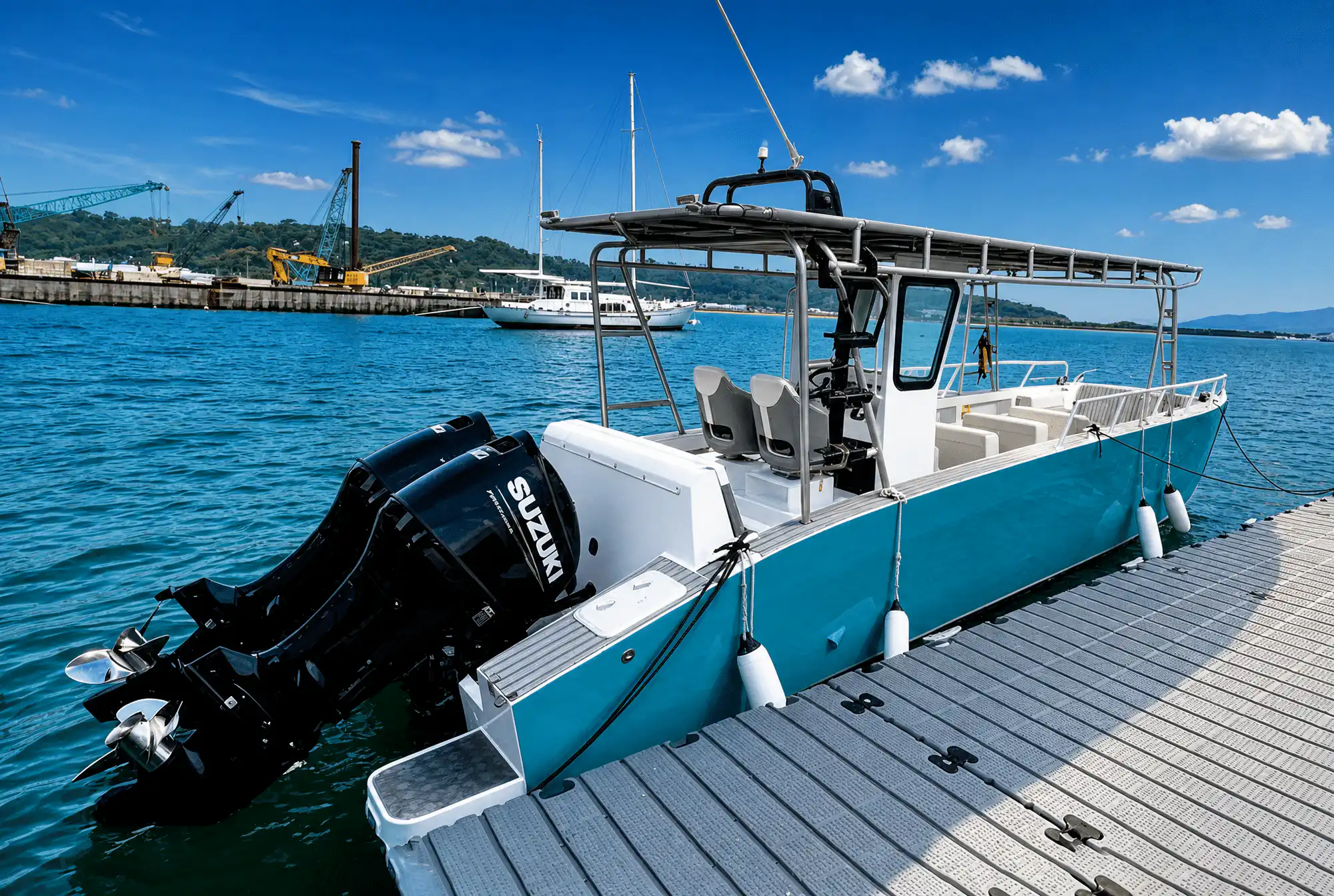
| 9m Landing Craft | 9 m (30 ft) | 2.45 m | 3 tons | Center console | Fast supply runs, island deliveries, crew transport |
| 10m Landing Craft | 10 m (33 ft) | 3 m | 4 tons | Enclosed cabin | Island resupply, passenger transfers, small cargo |
| 11m Landing Craft | 11 m (36 ft) | 4 m | 5–6 tons | Enclosed wheelhouse with bathroom | Crew transport, island logistics, vehicle deliveries |
| 12m Landing Craft | 12 m (39 ft) | 4 m | 6 tons | Flybridge wheelhouse with bathroom | Fast cargo runs, island ferry work, coastal support |
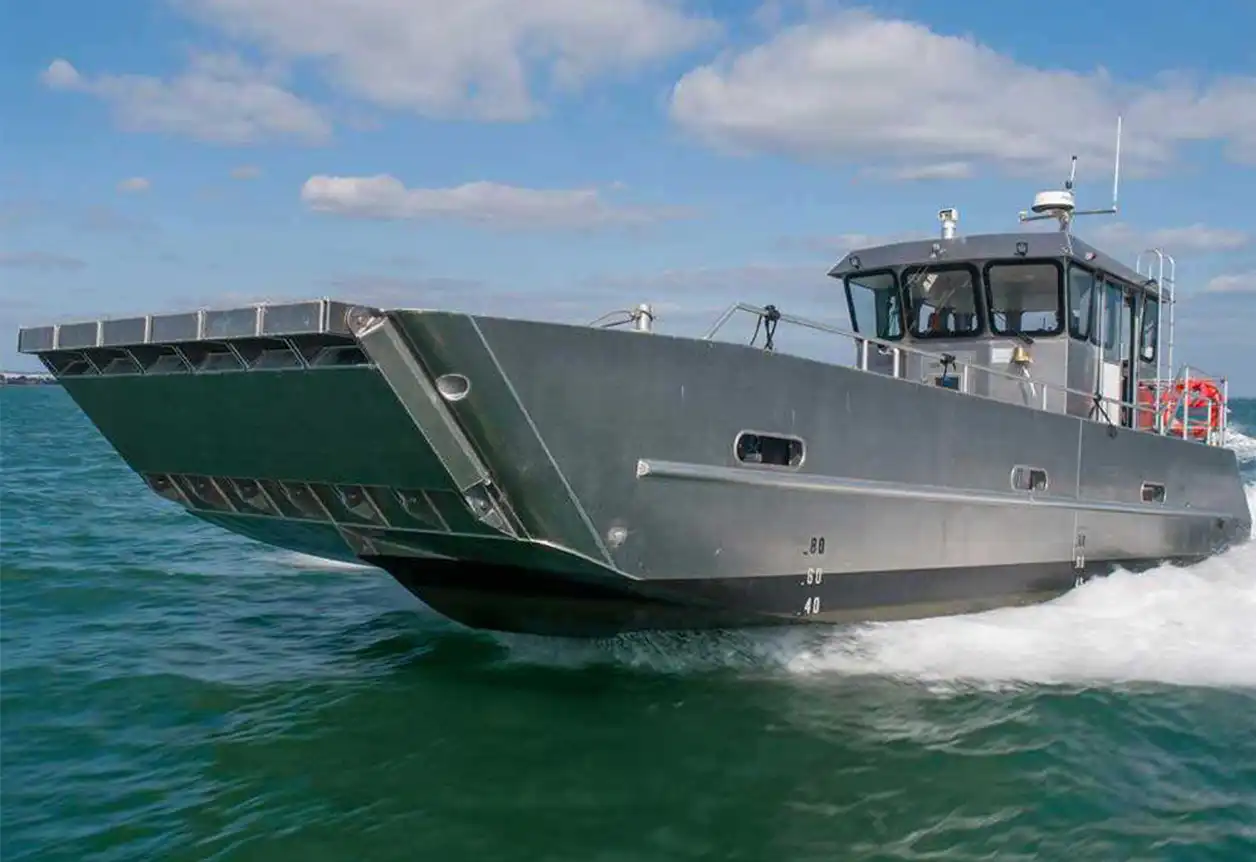
| 14m Landing Craft | 14 m (46 ft) | 5 m | 8–10 tons | Flybridge cockpit over an open deck | Heavy logistics, vehicle transport, construction supply |
| 15m Landing Craft | 15 m (49 ft) | 5 m | 5–10 tons | Open bow with a 4 m wide ramp | Oversized equipment, vehicles, heavy cargo |
| 18m Landing Craft | 18 m (59 ft) | 5 m | 15 tons | Open deck with cabin | Cargo, crew transfer and diving support in one hull |
| 21m Cargo Landing Craft | 21 m (69 ft) | 5 m | 20 tons | Large open deck | Heavy logistics, vehicles, research support |
| 21m Passenger Landing Craft | 21 m (69 ft) | 6 m | 25–30 tons | Fully seated deck for up to 100 passengers | Island ferry services |
Passenger capacity on any model depends on the rules in your country.
A few rules of thumb help you pick between sizes:
- Size for your typical load, not your record load. Add a margin of 10–15% for pallets, lashing gear and fuel. If an occasional load is much heavier, two trips may cost less than a larger hull every day.
- Check deck dimensions as well as tons. Vehicles and machinery usually run out of deck length or ramp width before they run out of payload.
- Plan for growth. If you expect your business to grow, a slightly larger model saves replacing the craft in two years.
- If berth length limits you, a wider beam on a shorter hull may give you the payload you need.
Our range falls into four groups: small landing craft (7.9–9 m) for light, fast work; civilian landing craft (10–12 m) with cabins for longer days; landing craft for heavy work (14–15 m) with crane-ready decks; and commercial landing craft (18–21 m) for 15–30 ton loads or high passenger numbers. If you are weighing one larger craft against two smaller ones, see why the 18 m model is an all-rounder and why a lower payload can still pay.
3. Check Water Depth, Beaching Conditions and Sea State
Draft decides where you can land. The shallowest point on your route must be deeper than the craft’s draft at full load, not just when empty. On our range, several of the smaller and mid-size models draw only about 0.3–0.4 m; larger models draw more. Check the exact figure on each product page against your own depths.
Beaching also depends on conditions you cannot change:
- Tide: at low tide more beach is exposed and landing is easier; at high tide the hull may not settle onto the beach at all.
- Beach slope and bottom: gently sloping sand is ideal. Mud needs a light hull and a flat bottom; gravel and coral call for thicker bottom plating.
- Waves at the shoreline: a beached craft needs to stay square to the waves while loading.
Our beaching guide covers each of these in detail, and how shallow draft landing craft work explains the hull design behind them. For delivering cargo straight onto beaches, see beach cargo delivery.
On rivers, current, moving sandbars, low bridges and overhead lines matter as much as depth. Air draft, the height from the waterline to the highest point of the craft, can rule out a flybridge. See can landing craft be used on rivers? and landing craft on inland waterways.
Finally, be realistic about sea state. Flat-bottomed and shallow-V hulls are built for coastal and sheltered waters. Match the craft’s design category to the wave heights on your route; our article on how aluminum landing craft handle wind and waves explains how.
4. Pick a Layout That Fits Your Crew and Cargo
Layout decides how comfortable the crew is, how much deck stays free and which jobs the craft can do. The main options are:
- Center console: light, fast and simple, with the most open deck for its size. Best for short runs in good weather, as on the 9 m model.
- Wheelhouse or enclosed cabin: protects the crew from sun, wind and spray on longer working days. Our 7.9 m, 10 m and 11 m models use this layout, and the 11 m adds a private bathroom.
- Flybridge: puts the helm above the deck, which gives a clear view over cargo and leaves the deck below free. It suits craft of about 12 m and above; see why add a flybridge to a landing craft.
- Open deck with a wide ramp: for vehicles, machinery and oversized loads, as on the 14 m, 15 m and 21 m cargo models. Decks can be prepared for a crane.
- Passenger seating: fixed or removable seats, shade and safe boarding. See passenger landing craft for direct beach access and passenger vs cargo landing craft.
Side doors and hull-side fittings add flexibility without taking deck space. A side door lets people board where the bow ramp cannot be lowered, and a dive ladder turns a cargo craft into a dive support platform. See side doors on landing craft and what the hull sides are used for.
5. Power, Speed and Range
Most landing craft up to about 11 m run on outboards. They are light, easy to service and can be swapped quickly if one fails. Twin outboards add redundancy: if one engine stops, the other can still bring the craft home. Above about 11–12 m, inboards become worth considering for passenger work and long continuous runs, because they are quieter and often more economical. Our article on inboard vs outboard engines compares the two in detail.
Recommended power rises with size: about 150 hp on the 7.9 m model, 300–500 hp on the 9 m, and 600–1,200 hp on the 14 m, 18 m and 21 m models. Each product page lists the recommended range. We can supply and pre-install Yamaha or other outboard brands of your choice.
When comparing speeds, look at cruising speed with a typical load rather than top speed when empty. Cruising speed decides how many trips you make in a day and how much fuel each trip uses. See landing craft speed by model and load.
Range depends on fuel capacity. Our tanks run from 300 liters on the 7.9 m model to 3,000 liters on the 21 m passenger model, and a larger tank can be fitted when your routes are long.
6. Hull Material and Build Quality
Most commercial landing craft built today are aluminum. Marine-grade 5083-H116 alloy is the usual choice: it resists seawater corrosion, and an aluminum hull typically weighs 30–50% less than a steel hull of the same size. The lighter hull draws less water, needs less power and does not need regular rust removal and repainting. Aluminum is also easy to modify later and fully recyclable. See marine-grade aluminum materials, aluminum, steel or FRP? and why modern landing craft are built from aluminum.
Plate thickness is a good first check of build quality. Our 7.9–11 m models have 6 mm bottoms; the 12 m and larger models have 7 mm bottoms and 6 mm sides. If you land on gravel or coral, ask for a thicker bottom, keeping in mind that extra plate adds weight and reduces payload.
Welding matters as much as the plate. When you compare builders, ask:
- Who does the welding, and are the welders certified?
- Are critical welds tested, for example by ultrasonic testing?
- Is every hull leak-tested before delivery?
- Will you receive material certificates for the aluminum plate and the welding procedure qualification?
- Can you visit the factory or receive photos and video during the build?
Our article on how aluminum landing craft are built walks through each stage, from design and cutting to welding, painting, outfitting and sea trials.
7. Options and Customization
A landing craft is usually built to order, so the standard model is a starting point. Common options include:
- Manual winch or hydraulic bow ramp, and the ramp width and length for your vehicles and beach slope
- Deck crane or boom, with a reinforced base
- Cabin, flybridge, sunshade or awning
- Passenger seating, handrails and a bathroom
- Side door and dive ladder
- Larger fuel and water tanks
- Navigation and communication electronics
- Heavy-duty fenders and thicker bottom plating
- A trailer designed to fit the hull
Every option adds weight and cost and may take deck space. Split your list into must-haves and nice-to-haves before you ask for a quote. Our guide to landing craft customization options explains the choices in more detail.
8. Rules, Registration and Certification
Check the rules at your destination before you order, not after delivery. The most important question is whether you will carry passengers. In most countries a craft that carries passengers commercially is regulated as a passenger boat, with stricter requirements for stability, seating, life-saving equipment and inspection. An island resort that buys a cargo version and later wants to carry guests may face costly retrofits. Our article on passenger and cargo landing craft explains the differences.
All of our models are CE certified. CE marking under the EU Recreational Craft Directive covers recreational boats, while commercial passenger operation is regulated separately, so confirm local registration and licensing requirements with your maritime authority. Ask your builder which technical documents they can supply for registration, such as drawings, material certificates and test records, and check that any certificates you are shown are current.
9. Budget and Total Cost of Ownership
The price of a landing craft depends mainly on its length and beam, plate thickness, cabin or flybridge, engines and electronics, the type of bow ramp and the options you add. Shipping also varies with the size of the craft and your destination port.
An aluminum landing craft usually costs more to buy than a steel one, typically 15–25% more. Over its working life, fuel savings, lower maintenance costs and higher resale value usually recover the difference within 3 to 5 years. See why aluminum landing craft suit commercial use.
The fairest comparison is with what you spend today. Add up a year of barge fees, boat rentals, dock charges and delays, and compare that with owning a landing craft that lands where you need it. For many island and coastal operators, the answer is clear.
10. Ordering From a Factory: Lead Time, Payment, Shipping and Warranty
Most landing craft are built to order, so plan the purchase around the build time. Here is how ordering works with us; other factories work in a similar way.
- Lead time: delivery normally takes about 120 days after we receive your advance payment. The exact time depends on the model, its specification and the number of units.
- Payment: by T/T, with a 30% deposit, 40% when the hull is completed and the remaining 30% before delivery. We send photos of the finished landing craft and its packing before you pay the balance.
- Shipping: depending on size, landing craft travel on flat-rack containers, as break-bulk cargo or on RoRo ships. We quote on EXW, FOB, CFR or CIF terms and can include freight.
- Packing: each landing craft is wrapped in protective film; crating or other packing is available on request.
- Warranty: every hull comes with a 3-year structural warranty. Outboard engines, electronics, hydraulics and other purchased components are covered by their original manufacturer’s warranty.
Also allow for import duties, local registration and the time it takes to clear the craft at your port. If you are buying from China for the first time, our article on buying aluminum landing craft from China covers what to expect, and About Us describes our factory and team.
11. After Delivery: Keep It Working
Aluminum landing craft need little maintenance, but a few habits make a big difference: rinse the hull, ramp hinges and engines with fresh water after working in seawater, check and replace sacrificial anodes, inspect the hull and welds after hard landings, and lay the craft up properly when it is out of service. Our landing craft maintenance guide covers each step.
Buyer’s Checklist
Before you request quotes, have answers to these questions:
- What is the heaviest single item, and what is a typical load per trip?
- How deep is the shallowest landing point at low tide, and what is the craft’s draft at full load?
- What deck length and width do your vehicles, machinery or pallets need?
- How many crew and passengers will you carry, and what do local passenger rules require?
- Do you need an open console, a cabin or a flybridge?
- Outboard or inboard power, single or twin engines, and what range?
- What bottom plate thickness, and which material and weld inspection documents will you receive?
- Which options are must-haves, and which are nice-to-haves?
- Which shipping method and Incoterm, and what duties and registration apply at your destination?
- What does the warranty cover, and is it written into the contract?
Frequently Asked Questions
What size landing craft do I need?
Start from your typical load and your shallowest landing point. As a guide, our 7.9–9 m models carry up to 3 tons for light, fast work; the 10–12 m models carry 4–6 tons and add cabins; the 14–15 m models carry heavier equipment; and the 18–21 m models carry 15–30 tons or large numbers of passengers.
How shallow can a landing craft go?
It depends on the model and its load. Several of our smaller and mid-size models draw only about 0.3–0.4 m. Always compare the full-load draft with the shallowest point on your route.
Can a landing craft carry a pickup truck?
Yes. Mid-size models such as the 11 m can carry a pickup truck, and the 14 m can take two trucks. Check the vehicle’s weight, length and width against the deck and ramp.
Is aluminum better than steel for a landing craft?
For most commercial work, yes. Aluminum is lighter, so it draws less water and uses less fuel, and it does not rust. It costs more to buy, but the difference is usually recovered within a few years.
How long does it take to build and deliver a landing craft?
With us, about 120 days after the advance payment, plus shipping time to your port.
Can you build a landing craft to my specification?
Yes. Hull size, layout and equipment can all be customized. Contact us with your application, typical load, landing conditions and destination port, and we will recommend a model and prepare a quote.